PROCESS DEVELOPMENTPRODUCT ENGINEERING
STRIP MORPHOLOGIES
Complex geometries. Lightweight structures. Any scale.
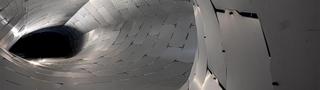
Lamina is a construction technology based on the assembly of ultra-thin metal strips, connected through overlapping tabs and rivets — no hidden substructures, no panels. The surface is the structure. Form, strength and continuity emerge exclusively from the geometry of the assembly.
The System
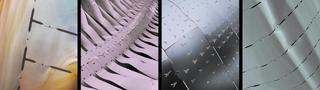
The starting point is a computational mesh subdivision process: the three-dimensional surface is discretized into a sequence of variable-profile strips, each producible from a flat sheet with a single cut. The rivet joint is not a detail to conceal — it is the fundamental constructive element of the system, visible and rhythmic.
Scale and applications
The construction principle — strip, tab, rivet — works identically on a 4-metre cladding and on a 400-square-metre structure. The logic does not change, the process does not change, the precision does not change.
Interior and exterior. Walls, ceilings, facades, canopies. Geometric variations modulate acoustics, light and spatial definition within a single system.
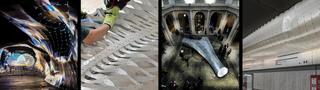
Self-supporting structures for trade fair, museum and temporary display contexts. Assembly and disassembly guided by automatically generated technical documentation.
At architectural scale, Lamina becomes inhabitable structure. Low self-weight, high formal complexity, geometries impractical with conventional construction systems.
Materials
For interiors:
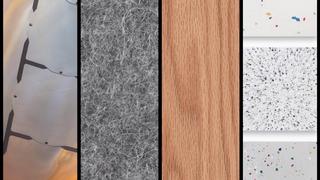
thin-gauge aluminium, high-density composites, wood veneer, technical felt, recycled polymers.
For exterior and structural applications:
anodised aluminium, stainless steel, galvanised or weatherproofed sheet metal.
Available finishes:
anodising, lacquering, texture treatments.
Strip thickness is a design parameter:
it determines rigidity, bending radius, weight and visual legibility of the profile in section.
The Process
01 // Computational Design
The surface is discretized into strips through computational mesh subdivision. Curvature, angulation, spacing and density are design parameters fully controlled in Grasshopper.
02 // Mapping
AIVOX software assigns each strip a unique position and generates complete production documentation. Every element is identified and tracked from fabrication to installation.
03 // Design to fabrication
CNC, laser or waterjet cutting. Each strip leaves production already complete with tabs and rivet holes. No secondary operations required.
04 // Assembly
Assembly sequences automatically generated by AIVOX. The logic — strip on strip, tab on tab, rivet on rivet — is identical at any scale.
Why Lamina?
Complex geometries meet the limits of standard construction systems:
continuous curvatures, non-developable surfaces and large formats require costly, hard-to-repeat custom solutions.
Lamina makes geometric complexity industrially accessible with a single production system, from cladding surface to autonomous architectural structure.
Full formal freedom without scale constraints, complex geometries completely repeatable.
High-identity structures within industrial timeframes and budgets, fully tracked process.
Every element numbered, every sequence documented, every joint identical.
_____________________________________________________________________________________________________________________________________________________________
Develop your project with Lamina
The AIVOX team supports designers and architecture studios from geometry analysis through to complete executive documentation.
REQUEST A TECHNICAL CONSULTATION